Friday, April 10, 2020

Part II — What are you doing for others?


"Life's most persistent and urgent question is, ‘What are you doing for others?'" — Martin Luther King, Jr.

Today is my 44th birthday. It is my prayer that I live the remaining days of my life healthy spiritually, mentally, emotionally, physically and relationally.

In my last blog, I wanted to share five things that I focus on to be healthy. Here are the remaining five that make me feel alive.

No. 6 — Being
I am a fan of being places that challenge my perspectives. I have three barbershops that I frequent monthly. One is in Southwest Atlanta. One is in East Atlanta and the other is in Buckhead. My Buckhead barbershop is owned by Tommy Thomas, a good man who happens to be white and a Republican. I am also a good man. I am African-American and vote Democrat. I love hanging out in his barbershop hearing the perspectives of him and his patrons.

You can also find me mentoring youth in Bartow County, Buckhead and Bankhead monthly. I love people and I love learning about different cultures. I have been mentoring students monthly in Bartow County at Allatoona Elementary School for four consecutive years. Allatoona Elementary School is a Title I School that serves a majority of white and Hispanic students. I connect with them in that I was also born into poverty and had dreams that could become a reality with the right connections. For many of the students, I will be their bridge to their careers. That makes me feel good knowing that I can earn the trust of students, who according to negative rhetoric, are not supposed to trust me since I am an African-American man.

No. 7 — Fitness Training/Diet
I faithfully workout four to five days per week for an hour using a combination of elliptical and weights. I eat three clean meals per day for five to six days per week, and then I eat like a savage for the other two days. I changed my fitness and diet a couple years ago when my doctor told me that I was gaining too much weight and was close to being diabetic. As I considered the amount of money that I would have to invest in medicine, I was convicted and disciplined myself to take care of myself. My fitness training and diet gives me the energy I need to be a loving husband, father, son, brother, uncle, coach, Deacon, and so on. I want to be the best me I can be so that I can love others well.

No. 8 — Coaching
Before the word coach was used in sports, it was strictly used as a means of transportation. There was horse controlled by a coachman, and the coach was the compartment that passengers rested until they reached their destination. Coaching allows me to use my spiritual gift of discernment to serve others. Coaching is my earthly talent. It is what I do well. According to Malcolm Gladwell, it takes 10,000 hours of deliberate practice to develop a skill. I define a skill is something that you do well repeatedly without thought while under stress. I have coached for more than 40,000 hours over the last 22 years.

I love being called a coach. I believe it is an endearing and meaningful calling, just like being a pastor, doctor, military officer or an educator. Good coaching happens at 30,000 feet. That is where airplanes cruise to their destination far away. At 30,000 feet, big things look really small.

I remember one time one of our L.E.A.D. Ambassadors, D’Zayvias Sumter, told me I was like an airplane. When I am not in proximity to him and the other Ambassadors, I appear small (not insignificant) enough to fit in the palm of your hand. But when I land, I take up a lot of space.

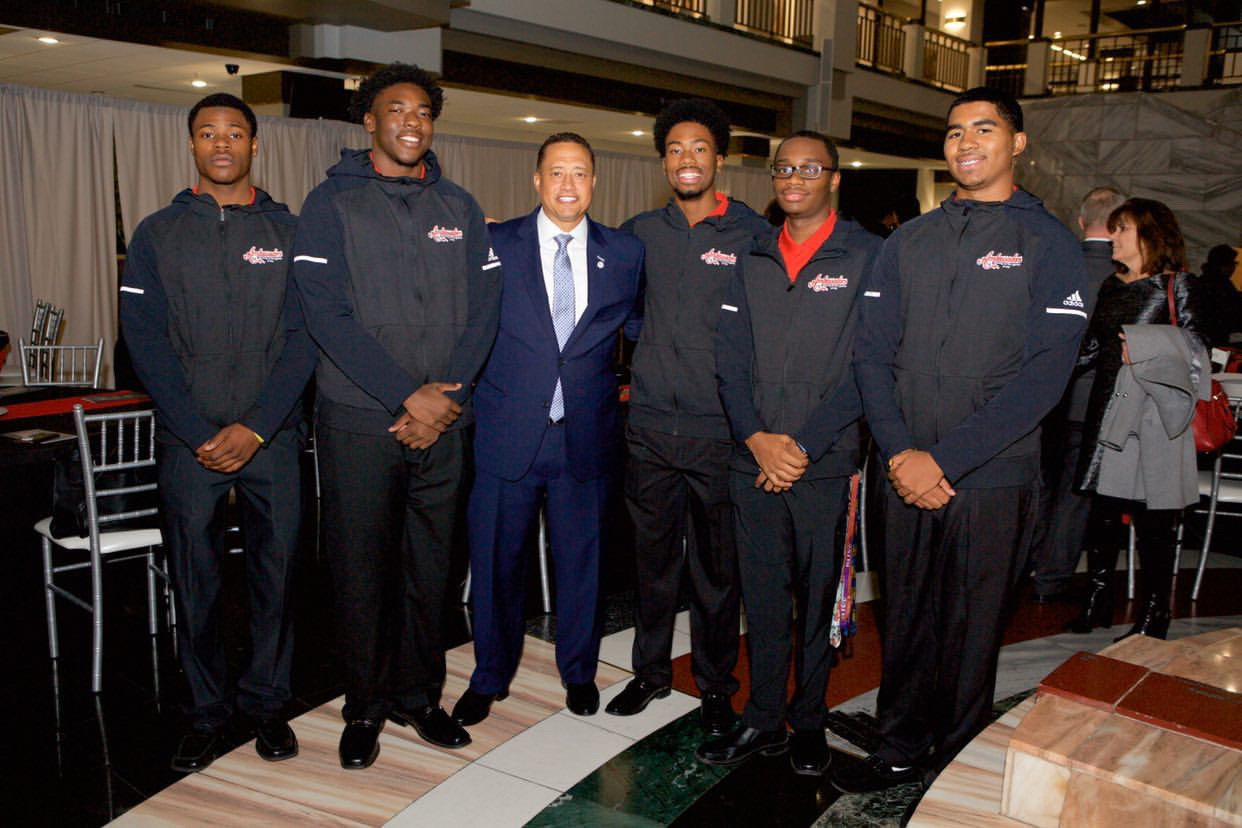
When D’Zayvias joined L.E.A.D., he did not like the accountability part of me. Now, he is an officer in the Marines and he loves it. I see myself as an air traffic controller. I give people the runway that they need to take off. I launch people. I use my spiritual gift of discernment and past mistakes that I have made to warn them and reroute them when danger is eminent. I help them land safely. If they do not land safely, I am there to serve them as well. And it is a beautiful thing when I can trust others to give me the runway that I need to get my plane in the air. Coaches need coaches, too.

No. 9 — Give
“You can’t give what you don’t have” is one of my favorite quotes. I am not sure who is the original author. It resonates with me because I believe in receiving so that I can give. I appreciate receiving in awards. On Nov. 20, 2011, I received a Proclamation from Atlanta City Councilman Michael Julian Bond. It was “C.J. Stewart Day” through perpetuity in Atlanta. I was recognized as “Mr. Baseball” by the Atlanta Braves 400 Club in 2018. In that same year, I was recognized nationally as a “Mentoring King.”

This year, I received the “Brian Snitker Award APIVEO Youth Coach of the Year.” I also received the “Taz Anderson Service Award” from the Georgia Sports Hall of Fame. My personal mission in life is to be significant by serving millions and bringing them into a relationship with Christ, starting with my wife, Kelli, and our daughters Mackenzi and Mackenna. I also believe that my birth city, Atlanta will only become a world-class city when hundreds of thousands of Black males are living a sustainable life of significance.


No. 10 — Leisure
Netflix, CNN and Facebook. I love watching Netflix. My all-time favorite Netflix show is “Narcos,” followed by “Trigger Warning” and “Malcolm X.” I got hooked on “Cheer,” “Friday Night Tikes,” “Tiny Houses,” “Last Chance U” and “Drugs, Inc.”

I spend a lot of time on Facebook learning from others and just socializing. When I post, it is with purpose.

Sunday’s – My Faith, Marriage & Stuff
Monday’s – Racism & Culture
Tuesday’s – Education
Wednesday’s – Social Impact of Sports
Thursday’s – Taboo Stuff
Friday’s – National Politics & Economic Development in Atlanta
Saturday’s – Silence or Sarcasm

I kickback and watch a lot of CNN. It is a trusted news source for me and I learn a lot about debating with civility when I tune in. I do not always agree with what is said, but it is always done civilly.

###

Thursday, April 2, 2020

COVID-19 — How to turn the name into an action that heals


According to the CDC, there currently is no vaccine to prevent us from the coronavirus disease 2019 (COVID-19).

Instead, we are left with several ways to stop the spread. The best way to prevent illness is to avoid being exposed to this virus altogether. The virus is thought to spread mainly from person-to-person—between people who are in close contact with one another (within about 6 feet). It also can be spread through respiratory droplets produced when an infected person coughs or sneezes.

COVID-19 has caused chaos for each and every one of us—uprooting our personal and professional lives, and forcing us to take deep precautions and exercise good judgement at every turn. Each day, I must remind myself that I have a calling to fulfill amid this chaos.

So how do I do it? It is in the name, COVID-19. I am:

C – Convicted | God’s way of keeping us on track
O – Optimistic | Hopeful and confident about the future
V – Valiant | Brave and courageous
I – Impassioned | Having or showing strong feeling about something
D – Definitive | Settling something finally with authority

According to the Bible, the No. 19 is used as a symbol of faith. It means that people who have faith in divine forces will have better lives, full of love and peace. People must have faith in Jesus and in his cross. It is written in the Bible that the people who listen to Moses are the people who have faith.

My spiritual gifts are discernment and hospitality, my earthly talent is coaching. Before the word coach was used in sports, it was strictly used as a means of transportation. There was a horse that controlled by a coachman and the coach—the compartment where passengers rested until they reached their destination. Coaching allows me to use my spiritual gift of discernment and hospitality to serve others well.

I am going to use COVID-19 as a framework to sustain me during this current time of chaos and prepare me for the next phase of trouble.

“I have told you these things, so that in me you may have peace. In this world you will have trouble. But take heart. I have overcome the world.” — John 16:33

Photo by Steve West

###

Tuesday, March 17, 2020

Top 10 things that keep me healthy — Part I


“Making it to the top is not the same as making it at the top.” — Tim S. Glover

God has been good to me. He has protected and provided for me my whole life even though I do not deserve it. His mercy and grace is sufficient. Unapologetically, I am a follower of Christ and it was conviction that connected me to Him.

I am 44 years old. Since 2007, I have served as the Chief Empowerment Officer for L.E.A.D. The assignment was one that I received from God in 2007—a convicting experience that changed my life.

Stan Conway is the father of Davis Conway. In 2007, Davis, a middle schooler, was one of my Diamond Directors’ clients. One day, after one of our weekly Hitting Lab sessions, Stan asked me what else I wanted to do with my life. It had been a long time since someone asked me that question.

I did not have an answer.

Stan threw me three pitches that I swung and missed on.


1. He told me that as good as I claimed to be as a professional hitting coach, my rates were too low.

2. He told me that as good as I claimed to be as a professional hitting coach, getting access to me was too easy.

3. He told me he was aware that there was a decline of African-Americans in baseball in America and that I needed to do something about it.

With Stan’s financial support, L.E.A.D., Inc. was established. L.E.A.D. stands for Launch, Expose, Advise, Direct, a 501c3 organization whose mission is to empower an at-risk generation to lead and transform their City of Atlanta. Through year-round, sports-leadership programming (baseball), we empower 350 Black boys from 6th-12th grades in Atlanta Public Schools to overcome crime, poverty and racism so they can win at the game of life.

“Hurting people hurt people.”

I am in a great place in my life. I am strong spiritually, mentally, emotionally, physically and relationally. Having good health allows me to serve others well and allows others to serve me well.

There are 10 things I have to do to maintain my health so that I can lead in Atlanta on purpose:

1. Worship/Praise/Prayer/Fasting
2. Rest
3. Conviction
4. Reading
5. Writing
6. Being
7. Fitness training/Diet
8. Coaching
9. Giving
10. Leisure

Here is a look at the first five. In my next blog, I will touch on the remaining five items.

No. 1 — Worship/Praise/Prayer/Fasting
I worship God the Father in the name of Jesus Christ because of who He is. My praise to Him is because of what He does. Worship is important to me to help me understand that I am on an assignment here on earth and that I have a calling to fulfill. God is not our personal genie and there are many prayers that go unanswered. I continue to pray to Him because of who He is and what He does. Fasting is a huge sacrifice for me because I love food and, at times, I worship it more than God. Fasting teaches me to depend on God and replace flesh food with His Word, which is spiritual food and prayer. Fasting takes the focus off us and our flesh and onto God. A posture before the Lord. Fasting in Hebrew means to “cover your mouth.”

No. 2 — Resting
To rest is to cease from working. God created the heavens and the earth, and then He rested (Genesis 2:2). It is hard for me to rest, but I do it so that I do not crash. I know it is time to rest when I get irritable and struggle to have joy. I also tend to gain a lot of weight when I need rest because I do not get adequate sleep, skipping meals, lots of fast food and late night binge eating. One of the blessings that I receive when I am well rested is clear communication from the Lord. 1 Kings 19 teaches us how the Lord speaks to us in a whisper. I want to hear Him. I need to hear Him in order to fulfill His will.

No. 3 — Conviction
According to the late Regi Campbell, “Conviction is God’s way of keeping us on track. Always respond, never ignore. It’s for our good and His glory.” Conviction motivates and empowers us, while guilt paralyzes. I am a fan of conviction because I believe that greatness cannot be imposed. It has to come from within. But it does live within all of us. Conviction hurts. Conviction allowed me to see Kelli Hampton for the first time and want her for my wife. We have been married for 22 years. Conviction is how L.E.A.D. was started. I go deeper in my book, “Living To L.E.A.D.: A Story of Passion, Purpose and Grit.”

I believe that conviction leads to change and change is needed in the US today because people are most comfortable with people who are like them. From a racial perspective, there are winners and losers, and African-Americans are losing a lot.

For me, conviction leads to connection with others. Connection leads to consensus and collaboration and ends with change. Being convicted by Christ has changed my character, which has changed my conduct. I coach starting with conviction, which leads to change.


No. 4 — Reading
As a child, I did not like to read because I associated it negatively with being a nerd. I also had trouble understanding a lot of what I was reading because I lacked knowledge about it. Knowledge is facts—information and skills that are acquired through experience. The words were information, but did not make sense because I lacked the knowledge. Now I love reading because I believe books are a source of information and inspiration that can lead to knowledge. And knowledge can heal and build a nation. I also believe that education is learning. It is what needs to be learned to do what needs to be done. My personal mission in life is to be significant by serving millions and bringing them into a relationship with Christ, starting with my wife, Kelli, and our daughters, Mackenzi and Mackenna.

No. 5 — Writing
Putting my thoughts on paper forces me to tighten my perspective and develop understanding about what I do, why I do it and how I do it. Writing has caused me to stop doing things that I am not doing well, which becomes a drain of my energy, time and/or money.

###

Sunday, February 2, 2020

African-American Assets that need Access

There is a large supply of African-American baseball players and the gap between them and the destination of competing at the collegiate and the Major League Baseball level is opportunity. Contrary to the rhetoric that African-American youth don’t want to play baseball, they do but lack the opportunity.

Kyle Bamberger is currently a scout for the Cleveland Indians and he recently graduated from UMass with his MBA and a MS in Sport Management. One of his assignments was a study on players from low-income areas. He contacted me to ask for my insights about the topic. I agreed to help him requiring that he ask me Should Ask Questions (SAQs) that are thought-provoking rather than Frequently Asked Questions (FAQs).


I’m an African-American man that grew up in poverty in the inner-city of Atlanta dreaming of playing professional baseball for the Chicago Cubs.

I had my first workout with the Cubs at age 14 because I had a sponsor, T.J. Wilson, that believed in me. I was drafted by the Cubs out of high school at age 18. Instead of signing a professional contract, I committed to attend Georgia State University (GSU). I played at GSU for one-year and transferred to DeKalb Junior College to be a student-athlete (baseball) the following year. I was drafted again by the Cubs at age 20 at the end of my sophomore season at Dekalb College. This time, I signed with the Cubs.

Below is my response to Kyle’s SAQs. My hope is that my responses convict and get us above rhetoric to solution so that baseball can truly be America’s Favorite Pastime allowing everyone to get in the game.

Where can we improve interest and access to the game for kids in low-income areas?
The theory that African-American kids don’t want to play baseball is a myth. They want to play; they just do not have the same opportunities. Youth baseball is one of the least expensive investments a family can make today. It can get expensive when a child sets his or her sights on playing at a higher level.

So I think we have to start there—with providing the proper opportunities. Kids living in lower income areas, of all races and ethnicity, do not have the same access to the sport as kids in middle class and upper class families. A young athlete living below poverty level has to really love the game to play. When I was a kid, I used to hit rocks with a bat for hours in the backyard or play catch with myself by throwing a ball into the air over and over.

In Atlanta’s inner city, we have been taking steps over the years to lay down a blueprint for how this is done. The development process from my non-profit organization, L.E.A.D. (Launch Expose, Advise, Direct), establishes a process in which young African-American boys cannot only learn the game, but have opportunities to do so. The process involves:
• Learning how to participate
• Learning how to practice
• Learning how to play
• Learning how to perform

Getting “quality instruction” does not always have to come with a price. Sometimes it is about being blessed enough to have the right opportunity, the right program and the right coach leading the way.

What are some of the barriers that players from low-income areas face?
They are societal (structural) racism, implicit bias, color-blindness and blackballing. Unfortunately, some people believe that the low-income culture is defined by drugs, violence and neglect, to name a few. In some cases, these assumptions are correct. But these communities also offer a culture of love, patience, discipline and guidance. There is a level of commitment and determination these young men exhibit that makes them truly unique. Nobody should be made to feel ashamed of where they come from.

How can the baseball industry help knock down these barriers?
Developing the skills and habits needed to succeed in baseball—or any other sport—means you have to make an investment, especially if your goal is to play the sport at a higher level. And those investments can be pricey. Along with playing in reputable, organized programs, young players looking to play baseball collegiately or professionally have to hone their skillsets through private instruction and showcases. These avenues take investments that equate to thousands of dollars over the years.

For kids in lower income families, these roadblocks are hard to get over. Being denied opportunities because of your economic class is an injustice. That is why so many student- athletes lean toward sports like football and basketball, where the odds for scholarship opportunities are higher. Because baseball scholarships are not as appealing as these other sports, the game misses out on the diversity needed to round out its participation numbers. Too many programs stereotype inner city kids as ones who lack the discipline needed to attend and succeed at a university setting.

I was able to compete as a student-athlete in baseball at Georgia State University in 1994 because I received money from the Pell Grant and HOPE Scholarship. For example, the Hope Scholarship is a merit-based program available to students who have met the University System of Georgia and GSFC's residency requirements and are enrolled in an undergraduate degree seeking program. It is available in other states under a different name.

The opportunity enabled a student-athlete like me, who possessed a high aptitude and the ability to be a critical thinker, to pursue the sport I loved. I graduated from high school with a B average and was able to qualify for federal government assistance based on my parent’s income. I played Division I college baseball without paying any money out of pocket.

C.J. Stewart, Terrance Wright, Ron Knight (Atlanta Braves, Assistant Director, Player Development-Operations)

Does the showcase circuit hinder opportunities for low-income players?
Yes. The youth baseball industry is more commercialized than ever before. The time and financial investment it takes to play in these types of tournaments is heavy. Kids living in low- income areas are being priced out of the opportunities. Too few highly talented low-income student-athletes are able to get the financial assistance needed to participate at this level.

How do you recommend providing better opportunities for these players?
Communication is everything. There needs to be better dialogue among college coaches about the high level of societal (structural) racism, implicit bias, color-blindness and blackballing that is being inflicted on these young men. York University professor Carl E. James once said that “a society is structured in a way that excludes substantial numbers of people from minority backgrounds from taking part in social institutions” To change the system, we need to change our way of thinking.

What changes need to be made?
During the 2017-18 NCAA Division I baseball season, there were 10,465 baseball players. Only 3.7% of them were African-American. To change the system, you need to provide more opportunities for kids from low-income backgrounds, especially that that are African-American. This is where the top amateur baseball players are competing. But because there are not enough opportunities, i.e., available scholarship distribution, the numbers for African-American student- athletes are low. However, poverty can afford opportunities.

One way to change the system is to encourage and empower more African-American coaches to lead collegiate programs. Another way is to foster more academic scholarship opportunities at the public school level, where students should be preparing to enhance their academic standings. If a talented low-income student-athlete has a promising college future, but attends a “bad” public school, his odds are lower. He cannot afford to attend a private school and he shouldn’t be forced to attend one.

Finally, I believe that White college baseball coaches need to give low-income African-American high school baseball players the benefit of the doubt—the way they do for White players.

What considerations are necessary to enable success at the professional level?
Statistics and metrics are used to determine which players are promoted through the Minor League system and into the Major Leagues. The low numbers of African-American players at the Major League level is a clear sign that the numbers are stacked against African-American players. This can create an environment where players African-American focus more on politicking than performing.

Where does the lack of understanding come from?
Ignorance, arrogance and intolerance. Everybody in the baseball industry knows there are not enough African-American baseball players in the sport. But there seems to be an ignorance when it comes to solving the problem. Being unwilling to address the problem is the problem—and that must change.

Change can be made through acceptance, commitment and action. Leaders in the baseball community must change their mindset and stop operating under the assumption that African- American boys do not play baseball because they do not have father figures in their households to teach them the game. They do not avoid the game because it is slow or boring. They do not always favor football or basketball. These are all ignorant assumptions.

More young African American young men will play the game when they are afforded the same opportunities as everyone else. It is up to each of us to make that happen. With organizations like L.E.A.D. (Launch, Expose, Advise, Direct), we can begin to carry the torch forward.

L.E.A.D. is a sport for social good organization that uses baseball to help at-risk, African- American males in Atlanta Public Schools overcome three curveballs that threaten their success: crime, poverty and racism. L.E.A.D. was founded 12 years ago by Atlanta native and former Chicago Cubs minor league outfielder, C.J. Stewart, and his wife Kelli.

To date, L.E.A.D. has served over 3500 youth in Atlanta Public Schools from 6th-12th grades. Through our partnership with Atlanta Public Schools, we proudly report the following stats for youth who complete our programming: 100% high school graduation rate, 93% college enrollment rate, 90% scholarship rate, 19% college graduation rate and about 14% enter the military or workforce.

###

Wednesday, January 1, 2020

The year 2020 - 20 questions that I have for 20 people

20/20 vision is said to be normal vision. At age 43, I find myself squinting a lot more these days. It’s been a while since I’ve had a sight test but I bet I’m moving towards needing glasses to see.

With regards to discerning my future for the year 2020, there are 20 people that I would like to meet. Upon meeting them, I already have the question prepared that I want to ask them.


1. Gucci Mane - What's your response to "successful" adults that tell youth that want to become a rapper that they should strive to do something else?

2. Big Meech - What's the best advice that you received from someone when you were a child that had you listened, would have prevented you from starting the Black Mafia Family?

3. T.I. - What are the principles of “street life” that are transferrable for launching a new business?

4. Barack Obama - Using 30 words or less, why can't we close the racial wealth gap in America?

5. Donald Trump - What was your initial reaction to the "Make America Great" mantra when it was shared with you to be used for your Presidential Campaign?

6. Tyler Perry - How do you define grit?

7. Brené Brown - If courage were an animal, what would it be?

8. Condolezza Rice - Using 30 words or less in a sentience, what’s the difference between the Republican Party and the Democratic Party?

9. Serena Williams - As a child, what were you considering as a backup plan if you didn’t become a professional tennis player?

10. Ayanna Pressley - You are quoted as saying, “Those closest to the pain should be closest to the power.” What inspired you to make this profound statement?


11. Nick Saban - If you were offered and accepted the head coaching position for the Atlanta Falcons, what would be the first thing that you would do to help us win a Super Bowl?

12. Tom Brady - In Super Bowl 2017, y’all were down 28-3 at halftime. What were you saying to yourself in the locker room during that time?

13. Ed Bastain - 
Atlanta being regarded as "The City Too Busy to Hate" helped us prove to be "more progressive" than other southern cities during the 1960's. The slogan was great for business. How do you feel about Atlanta having the greatest income disparity in America?

14. Rosalind Brewer - What’s step #1 to making a company culture racially inclusive?

15. Tucker Carlson - What’s the fundamental difference between Fox News and CNN? How are they both the same?

16. Ibram X. Kendi - “How to Be an Antiracist” is a powerful book that you wrote. What’s the most disappointing feedback that you’ve received from an African-American reader about the book?

17. Simon Sinek - What’s the craziest title for one of your books that you’ve considered but didn’t pull the trigger on?

18. Ta-Nehisi Coats - What are the top three things that a U.S. President must do to prove that he/she believes that Black Lives Matter?

19. Rob Manfred - What is the major consequence of having such a low number of African-Americans that are competing in baseball at the Major League level?

20. Michael Eric Dyson - What book are you reading right now?

###

Friday, December 6, 2019

What I want — How 2020 will continue to define who I am


I am imperfect. We all are. I am a product of my past. But my future is hopeful. As I look at my life up until this point, I see that conviction has connected me to a life of purpose. You can see me, but you cannot see my soul. I’m living on purpose and I know where I want to go.

I believe it is important for each of us to write down the things we want to accomplish, the people we want to meet, the changes we want to make for ourselves and the world around us. Here’s a look at what I hope to accomplish in 2020:


1. I want to draw closer to God, trust myself and live a life that honors my wife and daughters.

2. I want the new Atlanta Public Schools Superintendent to respect the culture of sports as co-curricular rather than extra-curricular.

3. I want the Atlanta Public Schools Board of Education to propose mandatory African American history classes within all middle and high schools in all Atlanta public schools.

4. I want Atlanta citizens by the hundreds of thousands to be aware that we are not yet a “City too Busy to Hate.”

5. I want Atlanta citizens by the hundreds of thousands to be aware that our state has a problem being in the top third of non-profits in the US, yet for the second year in a row, “Atlanta is the capital of U.S. inequality,” according to a Bloomberg analysis of large American cities with a population of at least a quarter-million.

6. I want to vet 20 volunteers for L.E.A.D. who can serve our Ambassadors by being a present, being present and being a partner.

7. I want the Braves to win the World Series and the Falcons to win the Super Bowl.

8. I want to read at least 20 books.

9. I want to start writing my second book.

10. I want the L.E.A.D. Ambassadors book, “Voices of the Counted Out” to sale more than 50,000 copies.

11. I want at least 100 fans at each of our spring L.E.A.D. Middle School Character Development League games. The MSCDL schedule will be posted by Feb. 1, 2020.

L.E.A.D. Ambassadors along with Chief Patrick Labat
12. I want 200 people to march with us for our Spring L.E.A.D. Inner City Youth Baseball March. The MSCDL schedule will be posted by Feb. 1, 2020.

13. I want to do another Spartan Race with the L.E.A.D. Ambassadors.

14. I want to run in the Peachtree Road Race with the L.E.A.D. Ambassadors.

15. I want to launch a capital campaign to raise funds for the L.E.A.D. Center For Youth.

16. I want Chief Patrick Labat to be the next Fulton County Sheriff.

17. I want to be wise and courageous while inspiring others to do the same.

18. I want to remain healthy spiritually, physically, mentally, emotionally, financially and relationally.

19. I want to remain unwaveringly committed to using my wealth of social capital to help tens of thousands of marginalized families in Atlanta.

20. I want to remain unwaveringly committed to being regarded as man of God who is aspirational rather than using bravado to become successful at the expense of others.

###

Monday, November 4, 2019

If It Ain’t Broke Don’t Fix It, but What’s Taking You So Long to Fix It if You Know It's Broke?


If a system works and is affective then great! If a system is not producing the intended results and you know it, then what are you waiting for to change it to one that will result in what you need; especially when its ineffectiveness has a long term negative impact on the lives of young people.

My wife, Kelli, and I founded an Atlanta based non-profit organization L.E.A.D., Inc. (Launch, Expose, Advise, Direct) 12 years ago. L.E.A.D. is a sport for social good organization that uses baseball to help at-risk, Black males in Atlanta Public Schools (APS) overcome three curveballs that threaten their success: crime, poverty and racism. Through our methodology, our young men become empowered to find success by embracing their education.

To date, L.E.A.D. has served over 3500 youth in APS grades 6 - 12. Through our partnership with APS, we proudly report the following stats for youth who complete our program: 100% high school graduation rate, 93% college enrollment rate, 90% scholarship rate, 19% college graduation rate and about 14% enter the military or workforce.

The systems we set up at L.E.A.D. to implement our programming need to work so that our young men can achieve the education success they must have to compete in life. We continually assess our programs and the systems we use. When we don’t get the results we need, we find a different way.

Despite our success, why does it feel that we are rolling a ball up hill when it comes to Atlanta’s graduation rate among Black males? Following are a few staggering statistics that I’d like you to share with you:

Based on a 2012 Schott Foundation report - Graduation rates for Black males in Atlanta 2009-10 42% and in Georgia it was 49%.

Based on a 2015 Schott Foundation report - Graduation rates for Black males in Atlanta 2011-12 was 38% and in Georgia it was 55%.

How is this possible? We know it isn’t a lack of resources and it isn’t lack of goodwill. Georgia has one non-profit charitable organization for every 361 people. It is ranked in the top 1/3 of most charitable states overall. Georgia’s charitable organizations are generous with both their money and volunteers. Could it be that those being served by the non-profit sector would benefit if there were an annual scorecard holding non-profits accountable for who and how they serve? Maybe, but that’s a discussion for another time.

We also know that the State of Georgia has a strategy for serving the educational needs of at-risk youth and systems in place to achieve their goals. So, why does Atlanta have so many problems with poverty and failed educational outcomes for young Black males? I think it’s because some of their systems are ineffective and it’s time to weed them out and replace them with what works.

According to a report issued by the Education Law Center one answer may lie in Georgia’s school funding formula: “Georgia is one of only eight states that provides no additional funding to students in poverty through the state’s school funding formula. Extra funding is, however, made available to districts if students test below grade level on Georgia’s English Language Arts or mathematics tests.”

In an AJC blog post dated August 21, 2019 by Maureen Downey entitled “Researchers say funding is not well targeted to districts with the greatest need” Ms. Downey refers to an Education Law Center report and introduces two researchers from the center, Mary McKillip and Danielle Farrie, to further explain in a guest blog, and advocate on behalf of Georgia’s at-risk student population. Following are outtakes from the blog post, more particularly the Education Law Center Funding Opportunity Fact Sheet that makes the case and provides for a system or funding formula.

According to the ELC Funding Opportunity Fact Sheet:

1. During 2017-18 - 52% of Atlanta Public Schools students live in poverty and 74% of APS students are Black. Based on this and the statistics listed above, one could assume the at-risk population in Atlanta Public Schools includes a high percentage of Black males.


2. Data to show why the current funding formula doesn’t work


3. How would Atlanta Public Schools benefit if the Quality Basic Education Formula Changed to a an ELC proposed Formula 


McKillip and Farrie give credit to Georgia legislature for taking “several positive steps to address over a decade of austerity cuts to K-12 education funding.” But are emphatic that “more can – and must – be done as Georgia ranks in the bottom quartile of states on public school funding. And there is an urgent need to drive more funds to address the impact of student poverty, especially in those districts serving high concentrations of students in need.”

“It’s time for lawmakers to tackle the challenge of providing additional funding to deliver essential resources to Georgia’s most at-risk students. These students deserve no less. “ Indeed.

###

Friday, October 25, 2019

Can sports help Black youth the way that it can White youth?


For all intents and purposes, I’m a Grady Baby. I was born in poverty in the inner-city of Atlanta. My mother, Gail, was 16 when she gave birth to me. She is the epitome of resilience and focus. My father, Willie, has always been in my life, and still models the qualities of commitment and discipline for me.

When I was a kid, young African Americans like me grew up hearing rhetoric like, “You could never be an athlete and intelligent at the same time.” Looking back, they were dumb jokes. What was real was the notion that while education could never be taken away from us, sports could.

As I grew older, I saw the pipeline of employment riding through the white community—one that helped young people prepare for the future. It was different for me. I was blessed to be on the right team, at the right time. I was coached by Emmett Johnson, Sr., who at the time was chairman of the Atlanta Public Schools’ Board of Education. I was also coached by Joshua Butler, a respected art teacher at Benjamin Mays High School. My family was not among the middle class, but my coaches were.

Playing baseball helped me build good habits, confidence and discipline. It shaped me into a community leader, teaching me how to strive for a goal, handle mistakes and cherish growth opportunities. Playing for Coach Johnson and Coach Butler gave me access. Through that access, I felt a sense of belonging to my birth city, Atlanta. I felt a sense of investment.

I dreamed of escaping poverty by entering the middle class.

My late mentor, Charles Easley, told me that ‘back in the day’, you did not become a man until you were allowed to play baseball. It was the principle he grew up under. Families would leave church and immediately head to the park to watch men play baseball. Sports like football and basketball were not even options. The University of Georgia recently uncovered the oldest known film footage of African-American baseball players. The footage is mesmerizing.

“I felt unhappy and trapped. If I left baseball, where could I go, what could I do to earn enough money to help my mother and to marry Rachel? The solution to my problem was only days away in the hands of a tough, shrewd, courageous man called Branch Rickey, the president of the Brooklyn Dodgers.” — Jackie Robinson

Atlanta is recognized as a world-class city. That would have never happened if it did not prove that it was a “city too busy to hate.” The transformation was set into motion when the Braves relocated here from Milwaukee. In fact, because of Jim Crow segregation laws, the Atlanta Braves were the first Major League team in the south.

Today, when I look out across our city, I see progress. Some of the progress can be traced back to sports. As the co-founder of L.E.A.D., I am able to use sports as a vehicle to help Black males in Atlanta’s inner city overcome crime, poverty and racism.

Photo of C.J. Stewart by Steve West
As a child, I experienced L.E.A.D. through the collaboration of my church, neighborhood public schools and local parks and recreation programming. We did not need non-profit organizations. Along with the guiding support of my family, I was able to get drafted twice by the Chicago Cubs. Without a college degree today, I am a husband, father, Deacon, author, business owner, and social activist who aims to attack policy that hurt the well-being of African Americans using sports as the vehicle.
L.E.A.D. is an amazing organization that offers amazing programs to young kids who otherwise might be counted out in Atlanta’s growing fortunes. Our organization would cease to exist if stringent policy ceased to exist.

As I continue to help build the minds and stature for some of Atlanta’s inner city Black youth, I cannot help sit back and reflect on how the road has led me to this place, at this time. As a husband and father, I am blessed to have had a hand in raising our children to always reach for the highest star.

My oldest daughter, Mackenzi, graduated from The Westminster School in 2019 with honors, while being a three-time state champion in tennis. Mackenna, my youngest daughter, is a 7th grader at The Lovett School. She is working to become a professional tennis player by age 15.

Both The Westminster School and The Lovett School are nationally respected institutions for sports and academics. Those are two of the reasons my daughters are a part of these K-12 institutions. The networking opportunities is the other. Mackenzi is a freshman student-athlete (tennis) at Howard University who is majoring in Afro-American History. She wants to be an education reformist who can educate and inform the masses about key concepts, events, people, etc., that were conveniently and intentionally left out of our history books. Mackenna wants to be a social activist.

At these schools, participating in sports and/or the arts is expected of everyone, regardless of their skill level. Being just a student today just is not going to happen.

The common thread of opportunity, as you can see, is that sports gives everyone a path toward intellectual, social and emotional growth. These are the very principles our L.E.A.D. Ambassadors embrace. The opportunity to step on to a playing field can be transformational. In sports, we find the balance between mind, body and spirit. It is just that this transformational experience must be something everyone—in all walks of life— should have the chance to develop.
The more level the field, the greater we can soar.

###

Wednesday, September 4, 2019

Why we are winning?


It all started in fall 2008, the time for my family and me to choose a new baseball organization. Now a sophomore at Benjamin Elijah Mays High School, I was looking for a program that could help me gain exposure to play baseball on the next level. My high school counselor, Andrew Ragland, saw my potential on the baseball field and gave me a flyer for tryouts for an organization called L.E.A.D.

At first thought, I told my mom they play at Perkerson Park—they can’t be any good. Having interest in organizations around Atlanta such as the Georgia Royals, MGBA (Marquis Grissom Baseball Association) and the Atlanta Blue Jays, I didn’t think L.E.A.D. would have much to offer. My focus was to find the best team, with the best players, and most popular brand. This way, I’d be able to travel, win games and be seen all over the country.

Upon arriving at Perkerson Park I was surprised to see so many people come out for tryouts. There was even lots of baseball gear and equipment available to the program that I could see with reps from Mizuno on site at the tryouts. My opinions had changed and interest had grew at first sight.

After completing the tryout process, my mom and I had a conversation with C.J. Stewart, the co-founder and CEO of L.E.A.D., Inc. (Launch, Expose, Advise, Direct). The first question he asked me was, “How are your grades?” My mom was sold. No other coach or organization was concerned with what I did off the field, but his first concern showed he cared and would not only help me on the field, but off the field, in the game of life, too. Our relationship took off from there, as I chose to join L.E.A.D., an unpopular choice at the time being the only Mays Raider to join the program. I found this experience more valuable in all of the losses that we took, not because we weren’t good players, but Coach C.J. and L.E.A.D. taught us how to see through the scoreboard and understand the real importance of travel ball.

The summer of 2011 had come around and it was time to make a decision on college. Still in the Ambassador program, I had become a Division I baseball prospect, being placed in front of colleges as well as professional scouts at every game and showcase. It was one day in particular I’ll never forget. It happened to be at Perkerson Park. The place I had doubts about when I first joinedg was now giving me the stage to perform on.

Before taking the field for the game that day, Coach C.J. pulled me to the side and basically challenged me to secure this Division I baseball scholarship to Grambling State University. The decision to stay and trust the process with L.E.A.D. had ultimately paid off. I can remember only winning about three to four games, but that was minor in comparison to winning the ultimate prize. I stayed with L.E.A.D. for the culture set in place—one that saw the big picture and was bigger than any game we could win.

Upon graduating from Grambling State University in 2017, I returned to Atlanta with my bachelor’s and master’s degrees, along with five great years on the baseball field. I began working with L.E.A.D. as the programs manager and Ambassadors head coach shortly after. Now approaching two years in this position, I have gained the experience and built a resume I need for the professional world. I have also embraced my passions for giving back to the community, leading and teaching, all while staying close to the game with coaching. These passions, in fact, are ones I’ll be looking to expand upon in my next job after moving on from L.E.A.D.

Head coach of the Ambassadors puts me in charge of three teams. We place Ambassadors on either the practice, play or performance team. The practice team does not play in any games. Once an Ambassador can show he knows how to practice, we will promote him to the “play” team. The process is similar to the minor league to major league progressions. Once an Ambassador is on the “play” team, his focus is to become consistent enough for a promotion to the performance team. The performance team is where you actually get to play for me, where my focus is winning games and scholarships.

I’m often asked after games—“Where are you guys from?”—due to the fact they are surprised that we compete or either won the game. The more surprising comments when I let people know all of my guys are from the Atlanta Public Schools system. I am not supposed to compete, let alone win games with this group. Each game I focus on pitchers throwing strikes, being solid on defense having timely hitting. If we do those three things well, we can compete with anyone.

Leading the Ambassadors did not start once I took this position. The journey started years ago watching and learning how to lead. When I matriculated through the program, there was no Desmond Stegall, C.J. and Kelli Stewart to lead us by themselves. Coach Kelli has taught me the importance of communication, holding people accountable and to sticking to my core values and beliefs.

Desmond Stegall leading the Ambassadors during the 2019 Safe at Home Game. Photo by iSmooth.

I also wondered for years how Coach C.J. managed to do all the things he had going on with excellence. He has taught me how to multi-task, how to prepare and how to delegate, because most things in fact cannot be done alone. I learn from them both each and every day. I use those skills and lessons as best I can when pouring into all the young men L.E.A.D. serves. Our mission is to empower an at risk generation to lead and transform their city. Coach C.J. and Coach Kelli provide Ambassadors this opportunity to do so. You are guaranteed professional coaching, lifelong connections and a network beneficial to your professional desires.

Preparation for the Ambassador program starts in our Middle School Character Development League. These participants are our Junior Ambassadors, who go through a 10-week process, where I am using a leadership method called “Habitudes,” founded by Dr. Tim Elmore. This core value training focuses on teaching Junior Ambassadors everything they need before they learn how to practice, play and perform.

As I close, I want to lend some words of advice to my successor on how to keep winning. You must understand that you are not only leading the Ambassadors, but serving them as well. Be knowledgeable of what each Ambassador can and cannot do. On the field, value each opportunity to get better as a team. Communication can go a long way in your coaching and the Ambassadors performance. You cannot stress it enough in every aspect of the game.

LEAD and they will follow.

BIO
Desmond Stegall is the L.E.A.D. Ambassadors Head Coach.

Thursday, August 22, 2019

Running. Reaping. Reciprocation.


On April 28, 2019, Pastor Charles Jenkins preached a sermon at my home church, Elizabeth Baptist Church, about three seasons of life—running, reaping and reciprocation.
  • Running Season — Faint not and let us not be weary in well doing
  • Reaping Season — Heavenly blessings come through human hands
  • Reciprocating Season — Blessed to be a blessing
Our oldest daughter, Mackenzi, is now a freshman at Howard University. She will graduate with a degree in Afro-American Studies 2023. Ultimately, she wants to help reform the K-12 education system in the United States. She will be a member of the tennis team, so be sure to follow her career here.

I remember when Mackenzi was born. I can still feel the excitement of being a first-time father. I remember crying when I dropped her off the first day of kindergarten. I remember when she became a teenager. And I will never forget the first young man who asked my permission to date her.


I didn’t cry when we dropped her off at Howard on August 11, 2019. I was too happy. Kelli and I have put a lot of work into Mackenzi’s development.

While driving to D.C. from Atlanta, Mackenzi launched an empowerment apparel line, “Know Your Truth? (KYT?)” The line is to educate and inform the masses about key concepts, events, people, etc., who were conveniently and intentionally left out of our history books.

Mackenzi Stewart. Photo by Steve West.
KYT? steps in where the K-12 educational system never picked up, providing basic, fundamental facts and truths about pivotal people, places and ideas in our society.

Kelli and I did a lot of running to get to this moment of reaping. Mackenzi is starting her running season at the Black Mecca.

Our youngest daughter, Mackenna, is a rising seventh grader at The Lovett School who aspires to become a professional tennis player as early as 15. She is passionate about social activism. Kelli and I are currently doing a lot of running with Mackenna.

Mackenna Stewart. Photo by Steve West.
Reciprocation for me will be when both of my daughters are married. I’m actually looking forward to it. I’m intentionally preparing them today to be a blessing to a man, like their mother is to me.

Running. Reaping. Reciprocation.

###

Wednesday, July 17, 2019

Why baseball really needs to be (all of) ‘America's Favorite Pastime’


Baseball is called America’s pastime. I have always wanted to believe that. I have spent my life chasing the dream and helping others do the same. When I look at the game today, I see it as a microcosm of the American Dream. Some people get what is needed to follow their path and enjoy the experience, while others do not. 

If you look closely at the decline of African-American participation in the sport, you will see what I see. The decline is a social justice issue that cannot be solved until we view it through that lens.

The issue is something that is near and dear to my heart. When I challenge white college coaches about not having as many African-American players as others on their rosters, many say their edict is to recruit the best players in order to win.


I do not believe that assessment measures up. For the past 20 years, I have lived and breathed the game of baseball, logging in more than 20 years of developing and scouting elite level players. I can tell you explicitly that African-American communities across the country are rich in baseball talent, proven by the fact that there already are hundreds competing at the NCAA D-I level.

This opportunity was made possible after Jackie Robinson carved a path for Dr. Martin Luther King, Jr.’s "I Have A Dream" speech. The trials and tribulations he endured proves, even today, that they must be adhered to with seriousness.

So yes, we need more Black boys to participate in baseball. To do so, we must first own up to the fact there are tens of thousands eagerly awaiting for their opportunity.

C.J. Stewart with youth in the Northwest Atlanta neighborhood that he grew up in. Photo by Eriel Dunnam.
During the 2017-18 school year, nearly 490,000 boys played high school baseball in the United States. Of that number, let us say that 10 percent were African-American. That is 4,900 African-American boys playing high school baseball. Is that number too hard to believe?

Rhetoric suggests that African-American males are “born good athletes,” yet some believe they are not capable of throwing, catching or hitting a baseball like the Negro Legends that helped save Major League Baseball.

Do you believe that?

Let us say that only 10 percent of those 4,900 African-American high schoolers playing baseball were “good enough” to compete in the classroom and on the baseball field at the NCAA D-I level.

That number is 490.

That means that at any given time, there should be close to 490 African-American males playing baseball at the NCAA D-I level. Why is it not a reality? I believe there are three threats impeding their progress:

1. Implicit bias
2. Colorblindness
3. Blackballing

To help turn this way of thinking around, I am proposing a five-point plan that every baseball organization and community can implement. Let us call it the 5 P’s:

1. Participate
There is no shortage of opportunities for African-American youth to participate in baseball because it is the easiest thing to organize. Participation is the first step to increase the amount of players performing at the collegiate and Major League levels.

2. Practice
Once a player demonstrates a love for the game at the participatory level, it is time to learn how to practice. Thisrequires commitment and discipline. Commitment is a promise made and kept. Discipline is doing the things that need to be done even when you do not want to do them.

Having a love for the game is important because you cannot master something without loving it. Players who love baseball possess commitment and discipline. If stressed properly, both of these characteristics should last a lifetime, helping a player win on and off the field. Commitment and discipline are skills that last a lifetime.

3. Play
Learning how to play baseball does not make sense if you do not know how to practice. Playing the game is nothing short of testing what you are working on at practice. Translation: Practice prepares you to play in the game, and the game dictates what you work on in practice.

Growing up, I did not have access to coaches who were former MLB players. Most of my coaches loved the game and a few played at the D-II level. I learned how to play under their leadership because they allowed me to play the game. We focused on the mistakes made at practice and learned how to make adjustments.

I remember playing in my neighborhood with a tennis ball, a stick and some friends. We received lots of reps uninterrupted by a “coach.” We were our own coaches. As we see too often, coaches can unintentionally coach the critical thinking skills out of a player.

4. Perform
When a player reaches the level that allows him to perform, he has earned the right to compete at the collegiate and/or professional level. Performance requires skills developed as a result of practicing under pressure. The skill yields game impact. Strike the right balance and you can avoid excuses like: "I’m tired." "I’ve never faced this type of pitcher." "I’m hurt."

Performance is the ability to get things done in spite of the circumstances. Players who perform know their ability so well that they can make guarantees and execute. They do not focus on getting hits; they focus on executing what it takes to get a hit (timing and tracking pitches, repeating their approach, etc.). Getting hits is the effect, not the cause.

Players cannot learn how to perform until they learn how to participate, practice and play.

5. Protection
The other P's do not mean anything if we are not protected. When African-American males do not feel their dreams are being protected, they oftentimes are unable to reach an optimum level of performance. Nobody wants to feel like they are doing something in vain.

African-American males often go unprotected because they are silent and deemed naturally resilient. Their silence could be the result of a lack of self-confidence. Their resilience could be the result of having to make things happen on their own.

Boys should not have to figure things out of their own. African-American males need heroes more than they need coaches.

As we see too often, structural racism is a real thing. It shows up in baseball as implicit bias, colorblindness and blackballing. It is time to break the chain.
###

Friday, June 7, 2019

Dreams. Worries. Questions. A LEAD Ambassadors’ Perspective


“Quality leaders recognize that life is pretty much about managing expectations— their own expectations and those of others. People can handle significant challenges—as long as they align with their expectations. Any time hardship fails to align with expectations, however, we can expect trouble.”
Dr. Tim Elmore

I have been the Chief Empowerment Officer for LEAD for 11 years and we partner with Atlanta Public Schools to empower an at-risk generation to lead and transform their city of Atlanta. LEAD Scouts The Counted Out. We use baseball as a vehicle to help youth black males overcome crime, poverty and racism. The over 350 student-athletes grades 6th through 12th that we serve earn the opportunity to become empowered by LEAD with the ABC'S ...


• Attendance
• Behavior
• Curriculum (grades)
• Service

LEAD stands for Launch, Expose, Advise, Direct. It is the gift God gave to me in order to live out my purpose on earth. We develop and position black boys to live sustainable lives of significance by freeing them from the stereotypes that keep them bound.

John Phillips
John Phillips is age 15 and a rising sophomore at Frederick Douglass High School. He’s been a LEAD Ambassdor for one year.

I recently asked him what he dreams about, worries about as well as the questions that people ask him that lets him know that they care about him. Here are his responses . . .

My dreams.

  • I dream about retiring from the MLB and starting a program like LEAD to help black kids be successful. 
  • I dream about making the people proud that helped me be successful. 
  • I dream about fixing poverty. 

My worries.

  • I worry about my grandad and dad not living long enough to see me be successful. 
  • I worry about letting everyone down that believes in me. 
  • I worry about not being successful as a result of leaving LEAD, dropping out of school and following the streets. I have no plans to do either one because LEAD has taught me how to be disciplined with my thoughts and actions. 

Caring questions.

  • Has everything been alright?
  • How have you been?
  • Did you make it home or your destination safely?
There are a lot of aspects of LEAD that I am proud of, and this one ranks high on my list - we are a meritocracy. A meritocracy is an elite group of people whose progression is based on ability and talent rather than class privilege or wealth. Because of this, we have what some believe to be a high attrition rate, around 15%-20%. Some of the attrition is due to lack of funding for staff, but most of it is because of the high standards we set. We are uncompromising in our expectations for our Ambassadors, and when they fail to meet these standards, they are met with the consequences. One such consequence is termination from the program, and when that happens we encounter quite a bit of criticism.

My stance is this: we cannot empower our youth to overcome their struggles by enabling them to use those same struggles as a crutch. Through stories they’ve shared with me, the Ambassadors have taught me how much they respect our organization by reaching for, and at times exceeding, our standards; even more so when they accept the negative consequences for not meeting the standards. Too many times they’ve told me that being in LEAD is the first time they’ve been held accountable on a consistent basis. For some reason, when it comes to helping Black males, most folks throw accountability right out of the window. This is exactly what they need; trust me, I know. Not too long ago, I was a teenage Black male walking the same streets as my Ambassadors walk today. I’ve overcome similar situations to theirs. The last thing they need is someone offering them benefits or opportunity without accountability.

Our Pathway2Empowerment model for our Ambassadors includes a K-12 education from Atlanta Public Schools, Core Value training via Habitudes®, and access to higher education via the military and/or the two to four-year college/university system. Ambassadors who work within our model and hold themselves accountable to it, go on to be employed at industry leading companies like Home Depot and Aerotek, and are well on their way to living a sustainable life of significance.

A great way for you to lead with us is by coming to a game this summer to support John. Here's a short video of the Ambassadors in action on the baseball diamond.


###

Wednesday, May 15, 2019

What does baseball have to do with transformation?


I cannot hide my anger to spare you guilt, nor hurt feelings, nor answering anger; for to do so insults and trivializes all our efforts. Guilt is not a response to anger; it is a response to one's own actions or lack of action. If it leads to change then it can be useful, since it is then no longer guilt but the beginning of knowledge.
Audre Lorde, Sister Outsider: Essays and Speeches

Change in Atlanta needs a name and it must start with passion. The Latin word for passion is suffering. A person cannot be passionate about a certain issue unless they first have experienced suffering centered around that issue. I am passionate about the well-being of marginalized people. Why? Because I have experienced their suffering first hand, felt the brokenness, seen the shame.

As a child being raised in the inner city of Atlanta, I was blessed to be raised with my mother and father in the household. My parents masked our poverty with nice clothes, proper grammar and social events like the Nutcracker.

My parents were hardworking striving to do good while living in the hood. Episodes of the Cosby Show and sleepovers at my white teammates houses when I was a teenager caused me to realize that my family wasn’t as financially successful as I thought that we were. I was embarrassed when my teammates would pick me up from our small house in Bankhead when I should have been appreciative that I had a home.

I’m happiest when marginalized people become the best version of themselves. When they don’t feel like outsiders, but are experiencing acceptance and opportunity, lifted to their rightful dignity of a being a beloved son or daughter of God. My journey from suffering to dignity to passion started over ten years ago. I grew tired of being selfish, pessimistic, arrogant and gave my life to Christ Jesus.


“Get all you can, can all you get, sit on the can.”----This was my slogan ten years ago and I’m not proud of it. I took an honest look at myself as my wife, Kelli voiced disappointment in me as a leader in my household. We have two daughters and I was treating everyone outside of my house better than them. Her words hurt me and led me to change.

I’ve been a baseball and life coach to thousands of males. They don’t begin to believe my success until they understand my struggle. Therefore, I always start with my story so that we can connect. I’ve loved baseball since the age of eight and I dream of using baseball as a vehicle to help legions of black males throughout Atlanta overcome crime, poverty and racism.


I want to increase the number of African-American student-athletes competing in baseball at the NCAA Division I level from 3.7% in 2019 to 40% by 2036.

Why baseball? Because baseball is considered “America’s game” and is used to develop character and critical thinking skills. Jackie Robinson made Dr. Martin Luther King ‪Jr’s‬ “I Have A Dream” speech believable. The Braves coming to Atlanta in 1966 during the Jim Crow era with Hank Aaron from Milwaukee was proof that Atlanta was truly a city “Too Busy To Hate”.

I believe that baseball is a microcosm of America. More blacks in baseball means more relationships between blacks and whites and America will reap benefits because decisions will be made for all with consideration for all.

We welcome you to come lead with us to fulfill our mission to empower an at-risk generation to lead and transform their city of Atlanta. You can be a prayer warrior for us, share your gifts and talents, show up at games and events, and make recurring donations. Use the following links to email us with any questions or comments you may have about signing on:

Click here to email us your prayer for us as well as 
share your gifts and talents with L.E.A.D.

###

Friday, April 26, 2019

Black Youth are Over Mentored and Under Sponsored


“But perhaps the most important difference of all and the one most dangerous to the American ideal of equal opportunity is in how we raise our kids. In the modern economy, human capital has become vital to success. The most educated and affluent parents got the memo. Upper middle class families have become green houses for cultivation of human capital. Children raised in them are on a different track than ordinary Americans right from the very beginning.”
Richard V. Reeves

Just like the minor leagues prepares professional baseball players for the Majors, so too must mentorship lead to sponsorship to prepare black youth for life.

My childhood dream was to become a rich Major League Baseball player for the Chicago Cubs. I wanted the cars and fame but lacked the character to make it a reality. I was selfish as a child and teen. My dreams did not include helping anyone but myself. I did get to play for the Cubs, though never made it to the Majors. After returning home, my wife Kelli and I founded a business, Diamond Directors, that provides top athletes with a blueprint of success. The selfishness is gone, which is why we also co-founded L.E.A.D., Inc. (Launch, Expose, Advise, Direct), where baseball is the blueprint to help inner-city, Atlanta Black males combat three curve balls they face in life - crime, poverty and racism.

Mentorship is guidance. Sponsorship is reliance. I believe that he who owns the definition owns the movement.

I’m currently reading Richard V. Reeves’ book Dream Hoarders: How The American Upper-Middle Class Is Leaving Everyone Else in the Dust, Why That Is A Problem, and What to Do about It. Among many things, the book introduced me to the terms “market meritocracy” and “market merit.”

The Business Dictionary defines meritocracy as “governance by elites who deserve to wield power because they possess merit (defined as 'intelligence plus effort') instead of by those who merely possess wealth or belong to privileged classes.” Such a system, in theory, forms the basis of an 'equal opportunity' society. But, in practice, unrestricted meritocracy may result in a society without rules and concentrate power in only a few hands. The term was coined by the UK sociologist Michael Young in 1958 book, The Rise Of Meritocracy. Richard V. Reeves, adds the term “market merit” to the conversation to highlight the emphasis on skills and attributes that predict economic success. We know that it is harder for some in our city to gain those skills, keeping them out of the meritocracy that runs our city.


L.E.A.D. Ambassador Justin Riddle. Photo by SMAX Photography.

I was born and raised in poverty in the inner-city of Atlanta, and I’m ashamed that we have the largest wealth gap among major cities in the United States. According to the Atlanta Chamber, if you are born into poverty in our city, you only have a 4% chance of making it out. Most people agree that the first step in changing this is education. Atlanta Public Schools (APS) educates over 51,000 students in grades K-12 and over 80% of those students live at or below the poverty level. APS is doing great things for Atlanta under the leadership of Dr. Meria Carstarphen, however, even if every Black student graduates from high school, that won’t be enough. Students living at or below the poverty level may get the education they need, but they still don’t have access to the opportunities that provide them access to the market meritocracy. Until we address this disparity, children born in poverty in Atlanta will never catch up; will never be able to live their “best life.”

People in this city want to help. The issue is that they aren’t helping in the right way. Georgia has one non-profit organization for every 361 people. Volunteers and money for inner city Atlanta are plentiful; the question is why aren't they more effective.

Unfortunately, for many black families living in poverty the only way their children can achieve merit is to leave their community to attend school. By restricting access to the levers of meritocracy to spaces outside the inner city, we perpetuate the “ghettoization” of our city. Those left behind fall further behind. Those who can, get out by attending charter or private schools, and stay out. What can we do to change this? We need to move from mentorship to sponsorship.

We need the volunteers and philanthropists who sit on boards to understand that our youth need access to the same opportunities that their White peers living five miles away have; otherwise their merit will never be enough to break into our city’s meritocracy. It is not enough to mentor them; they need to be sponsored for specific positions and opportunities.

What does that look like? This four-step process illustrates how we can sponsor Black youth that are living at or below the poverty level in Atlanta.

Conviction
Ask yourself, “Why do I care about Black students escaping poverty so they can enjoy a life of prosperity like I have?” Vulnerability is better than pageantry.

Connection
Determine what resonates with you when you ask that question, and then share that with the student you are mentoring. This will create a connection between the two of you which will be critical for moving from mentorship to sponsorship.

Consensus
Together, identify a specific career opportunity the young person wants to pursue and make a promise to him that you will personally help him navigate achieving it through your support and endorsement.

Collaboration
Work together to make sure that the student doesn’t just get the education he needs; but that he also has access to the opportunities that will make him marketable in our city’s meritocracy. This will require your time, money, and ongoing endorsement.

By sponsoring, and not just mentoring, our most vulnerable at-risk, Black youth, we can help make Atlanta a place where merit is rewarded regardless of the circumstance of birth. Only then will we live up to the promise of our meritocracy.

###